Friday, December 05, 2008

Pop Chemistry

I've been worrying about this too... someone has written an interesting blog post:

Pop Chemistry

In the seemingly never-ending series of reports on the health benefits/risks of coffee and soda, I see that drinking soda can weaken your bones. I’ve heard of this before, but this study appears to confirm it. There are basically 2 main theories about the cause. Theory 1 assumes that it’s the caffeine, since caffeine has been linked to a higher risk of osteoporosis. If so, then coffee drinkers have to worry about this too. Theory 2 suggests the phosphoric acid in soda reacts with and removes calcium from the body, which eventually results in its leeching from bones if you are not getting enough from your diet. Since I tend to snack on Tums, I’m probably in steady state with respect to my calcium. Actually I may be safe without the Tums since the article states: “The researchers didn't find an association between cola drinking and lower bone mass in men.” Woot!

I would like to propose a third mechanism for calcium removal. EDTA (ethylenediammine tetraacetic acid) is added to some sodas as a preservative. The ability of EDTA to wrap itself around metal centers would seem to make it a prime candidate for calcium removal. EDTA’s ability to tie up calcium ions is an essential part of the standard titrimetric analysis for calcium. In fact, EDTA should be able to chelate many of the metals inside our bodies provided the pH isn’t too low. So I admit to being pretty surprised the first time I saw EDTA listed as one of the ingredients in Mountain Dew back in the day. Why is EDTA added to soda in the first place? It’s there to prevent the formation of benzene, which was found to be formed by a reaction between sodium benzoate and ascorbic acid back in the late 90’s. Apparently, the reaction is catalyzed by transition metal ions such as Cu2+ and Fe2+ (usually supplied by the can) and the addition of EDTA to complex those metals solves the problem. Note: Not all sodas contain EDTA. In some cases the manufacturers just decided to remove the ascorbic acid instead.

Follow up: A little more research has revealed that the most common form of EDTA used is the disodium-calcium salt of EDTA. This means that the EDTA cannot be responsible for lowering the levels of calcium in the body. Damn, another personal theory down the drain.

Monday, November 24, 2008

Salmon with Fennel Onion Stuffing

Salmon with Fennel

Prep Time:
30 min
Inactive Prep Time:
0 min
Cook Time:
45 min
Level:
Intermediate
Serves:
10 to 15 servings
1 (10 pound) fresh salmon
5 cups sliced yellow onions, 1/4-inch thick (3 pounds)
5 cups sliced fennel bulbs, 1/4-inch thick (3 pounds)
1/2 cup good olive oil
3 tablespoons fresh thyme leaves, coarsely chopped
2 tablespoons coarsely chopped fennel fronds
1 orange, zested
2 tablespoons freshly squeezed orange juice
2 teaspoons kosher salt
1 teaspoon freshly ground black pepper

Have the fishmonger cut the head and tail off the salmon and butterfly it, removing all the bones. You should have about 7 pounds of salmon.

Preheat the oven to 500 degrees F.

Saute the onions and fennel in the olive oil for 10 minutes on medium-high heat, stirring occasionally. Add the thyme leaves, fennel fronds, orange zest, orange juice, salt, and pepper and saute for 5 more minutes, until the onions and fennel are tender. Taste for salt and pepper.

Lay the salmon, skin side down, on a cutting board and sprinkle both sides generously with salt and pepper. Spread the fennel filling over half of the salmon. Pull the other half up and over the filling, enclosing it. Tie the salmon every 2 inches with kitchen string to secure the stuffing.

Place a sheet pan lined with parchment paper in the oven for 5 minutes to heat it. Carefully transfer the salmon to the hot sheet pan and bake it for exactly 30 minutes (10 minutes for each 1-inch of thickness). Do not overbake!

Allow to cool slightly, then remove the strings. To serve, cut into thick slices with a very sharp knife. This salmon is delicious hot or at room temperature.

Note: If you're making this in advance, be sure to cool the filling before stuffing the salmon. Refrigerate until ready to roast.

Thursday, November 20, 2008

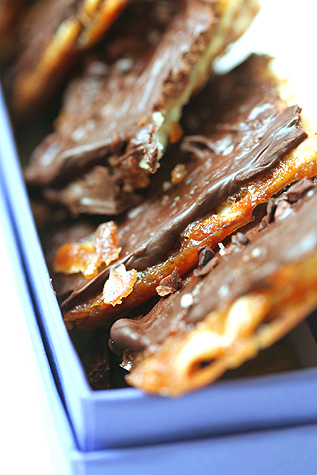
Chocolate-Covered Caramelized Matzoh Crunch

Chocolate-Covered Caramelized Matzoh Crunch


blogcaramelmatzohcrunchchoc

Seriously my friends, is there anything better than chocolate and toffee together?

Especially when the toffee has a brown sugar-flavored buttery snap and luscious chocolate is smeared over the top so it hardens and melds with the crackly caramelized matzoh underneath. When a marriage is this good, a picture can only do partial justice to the love that exists between the happy couple.

Shalom and gut yontiff to the happy duo!

The original recipe I presented a while back is great, but I thought I'd bring it up-to-date here, and present it once again since things get buried in archives and for reasons only the internet gods know, I can't retrieve them and give them a good shake. So I gave it a makeover (or 'relooking', as they say around here), tweaked it a bit, and enjoyed every bite along the way.

Since I'm turning back the time machine a bit, I hope for you, this recipe is unlike that Armani suit that 'someone' paid $2000 for and looked like a million bucks way back when but never wore. It would please me to no end if you find yourself taking this recipe out for a spin and using it all the time as I do.

Thankfully, this recipe doesn't have padded shoulders and an over-tapered waist, hence it should have a bit more staying power. (I still don't know what to do with that suit; it's still taking up some valuable real estate in my recently cleaned-out closet. Maybe I can be Vanilla Ice next year for Halloween?)

spreadingchocolate

The original recipe I adapted here didn't include salt in the toffee mixture. But I added a good pinch of it, as well as a soupçon of vanilla too. And there's no law (yet...) that says instead of pressing some crushed toasted nuts on the warm chocolate, go minimalist and simple sprinkle a few grains of fleur de sel and roasted cocoa nibs over the top.

Lastly, don't be tempted to get all fancy and eschew chocolate chips and chop up some top-notch chocolate for the coating. Since chocolate chips are designed to hold their shape and harden firmly after they're melted, here you have my permission to break open a bag of semisweet morsels and dump those little devils over the whole she-bang instead.

Some eagle-eyed folks will notice I used chocolate but that's because my chocolate chip stash got alarmingly depleted around the holidays. But here I'm advising you to do as I say, not as I do. And while I'm on my bully-box, I know I can't force you to make make this. Although don't say I didn't warn you if you do: it's almost impossible to stop snacking on. As Carol mentioned, it makes a pretty fine breakfast treat if you're lucky enough—or smart enough—to stash away a few pieces all for yourself.


matzohchocolatecrunch


Chocolate-Covered Caramelized Matzoh Crunch
Makes approximately 30 pieces of candy


This recipe is adapted from Marcy Goldman of Betterbaking.com, whose latest book is A Passion For Baking. It's super-simple and requires no fancy thermometer, equipment, or ingredients. If you can't get matzoh, use plain crackers such as saltines instead and omit the additional salt in the recipe. For passover or vegans, Marcy advises that it works well with margarine. And for our gluten-free friends, this would be superb made with any gluten-free cracker. I'd love to hear about any variations you might try with it.


4 to 6 sheets unsalted matzohs
1 cup (230g) unsalted butter, cut into chunks
1 cup (215g) firmly-packed light brown sugar
big pinch of sea salt
1/2 teaspoon vanilla extract
1 cup (160g) semisweet chocolate chips

1 cup (80g) toasted sliced almonds (optional)


1. Line a rimmed baking sheet (approximately 11 x 17", 28 x 42cm) completely with foil, making sure the foil goes up and over the edges. Cover the foil with a sheet of parchment paper.

Preheat the oven to 375F (190C).

2. Line the bottom of the sheet with matzoh, breaking extra pieces as necessary to fill in any spaces.

3. In a 3-4 quart (3-4l) heavy duty saucepan, melt the butter and brown sugar together, and cook over medium heat, stirring, until the butter is melted and the mixture is beginning to boil. Boil for 3 minutes, stirring constantly. Remove from heat, add the salt and vanilla, and pour over matzoh, spreading with a heatproof spatula.

4. Put the pan in the oven and reduce the heat to 350F (175C) degrees. Bake for 15 minutes. As it bakes, it will bubble up but make sure it's not burning every once in a while. If it is in spots, remove from oven and reduce the heat to 325F (160C), then replace the pan.

5. Remove from oven and immediately cover with chocolate chips. Let stand 5 minutes, then spread with an offset spatula.

6. If you wish, sprinkle with toasted almonds (or another favorite nut, toasted and coarsely-chopped), a sprinkle of flaky sea salt, or roasted cocoa nibs.

Let cool completely, the break into pieces and store in an airtight container until ready to serve. It should keep well for about one week.

Saturday, November 08, 2008

Persimmon Recipies

PERSIMMON PRESERVES
Take cultivated persimmons which are ripe yet firm. Allow an equal
weight of sugar. The fruit must lie in water for 12 hours. Stew the
fruit in water to cover until tender. Drain and spread out to become
cool and firm. Add a cup of cold water to every pound of sugar. Boil
and skim until clear, then cook the fruit in it about 10 minutes. Spread
on dishes in the sun. To the syrup, put the juice and peel of two lemons
for four quarts. Boil until thick and return the fruit to syrup for 20
minutes. Store in sterilized jars.
------------------------------


Persimmon Jelly
PREP TIME: 1 Hour
MAKES: 3 (1/2-pint) Jars


INGREDIENTS:

3 1/2-4 pounds ripe persimmons
2 cups water
3 tbsps lemon juice
1 package powdered fruit pectin
1/2 cup honey
METHOD:
Wash persimmons and remove blossom end. Place in a 6- to 8-quart stainless
steel or enamel saucepan. Add water. Bring mixture to a rolling boil. Mash
persimmons, reduce heat and simmer 10 minutes. Remove from heat. Press pulp
through a strainer to remove pits and measure 3 cups pulp. Stir in lemon
juice and pectin and bring mixture to a rolling boil. Stir in honey all at
once and let mixture return to a full rolling boil that can't be stirred
down. Boil for 1-2 minutes, stirring constantly. Do a jelly test and, when
firm enough, ladle into hot, scalded 1/2-pint jars. Leave a 1/4-inch headspace
and seal. Process for 5 minutes in a boiling water bath.
----------------------------


PERSIMMON JAM

Ingredients :
4 lb. very ripe persimmons
4 c. sugar

Preparation :
1. Cut persimmon in half and scoop out pulp. Press fruit through
a strainer. 2. Measure 4 cups pulp into 4 1/2 quarts pot. Add
sugar and stir well. 3. Cook over low heat, stirring constantly,
about 30 minutes. Remember not to boil or jam will be bitter. 4.
Ladle into clean hot jars, leaving 1/2 inch headspace. 5. Process
in boiling water bath for 10 minutes. Yield: 3-5 pints.
----------------------------------


PERSIMMON JAM

Ingredients :
3 c. persimmon pulp
3 c. sugar
1 tbsp. fresh lemon juice
1/2 tsp. grated lemon zest (lemon
peel)

Preparation :
Make pulp - 3 or 4 persimmons. Combine pulp and sugar in heavy
non-corrosive saucepan. Cook over low heat; stir constantly until
thick and opaque, about 15 minutes. DO NOT BOIL. Remove form heat.
Stir in lemon juice and zest. Pour into sterilized jars and seal.
May be used as a jam or fold into whipped cream and use as a filling
for cake or topping for gingerbread. LEDC
----------------------------------


PERSIMMON MARMALADE

Ingredients :
2 qts. ripe persimmons
1 c. sugar
1 c. orange juice
Grated rind of 1 orange

Preparation :
Cut up persimmons; discard seeds and cores. Mash fruit and cook
with sugar, orange juice and orange rind until mixture is thick.
Yield: about 6 half-pints.

Thursday, October 30, 2008

Baby Center Mommies' Favorite Recipies

Peppermint Meringues

Ingredients

2- egg whites

1/4 teaspoon- peppermint extract

1/8 teaspoon- cream of tartar

2/3 cup- sugar

3-5 candy canes-crushed

Directions

Lightly grease a cookie sheet; set aside. Preheat oven to 300 degrees. In a medium mixing bowl beat egg whites, peppermint extract, and cream of tartar with electric mixer on high speed until soft peaks form. Add sugar, 1-2 tbs. at a time, while beating with mixer until stiff peaks form. Then drop mixture by rounded teaspoons about two inches apart on the greased cookie sheet. Sprinkle each cookie with the crushed candy canes. Bake in the 300 degree oven for about 20 minutes, or until firm on the bottom and very lightly browned. Transfer to a wire rack to let cool. Then enjoy! Makes about 36 cookies.


Chocolate No-Bakes:

2 cups sugar
1 stick butter (1/2 cup)
1/2 cup Pet milk
1 teaspoon vanilla
2 1/2 tablespoons cocoa
1/2 cup peanut butter
3 cups oats

In a medium saucepan, combine all ingredients except peanut butter and oats and cook over medium heat. Let boil for 5 minutes, stirring constantly.

Remove from heat and stir in peanut butter and oats.

Spoon out quickly onto wax paper or aluminum foil. Cookies will harden as they set.


Cheesecake

Take 16 oz of cream cheese and 16 oz of sour cream. Blend together. Add 1 cup sugar, 3 eggs, and 1 tblspn of vanilla. Blend til creamy and smooth. Pour batter into ready made crust or homemade, whichever you prefer. Makes 2 cheesecakes, so you need 2 pie crusts. Put in the oven for 40-45 minutes at 350 degrees. Then turn the oven off and let it sit for an hour. NO PEEKING!


Nantucket Cranberry Pie

Ingredients

For the Filling:
Butter, to grease the pie plate
2 cups fresh or frozen cranberries
1/2 cup sugar
1/2 cup walnuts, chopped
For the Topping:
2 eggs
3/4 cup butter, softened
1 cup sugar
1 cup flour
1 teaspoon almond extract

Turn on oven to 350 degrees F. Place the cranberries in a buttered, 10-inch pie plate. Toss the sugar and walnuts over the berries. For the Topping: Cream the eggs and the butter with the sugar. Add the flour and almond extract to the mixture, lightly tossing with a fork. Pour the topping over the cranberry mixture and bake for 35 to 40 minutes. Serve warm with whipped cream.


Pumkin Pie with Cookie Nut Crust


1 1/4 cups flour

1/4 tsp baking soda

1/2 cp margarine (softened)

1/2 cp loosley packed brn sugar

1/2 cp finely chopped walnuts

1/2 tsp vanilla

1 1/2 tbsp cornstarch

1/2 tsp ground cinnamon

1/2 tsp ground ginger

1/4 tsp ground nutmeg

1 cup granulated sugar

1-15 oz. can libbys pumpkin

1/2 cp light cream

2 eggs

2 tbsp molasses


Preheat oven to 350. Combine flour and baking soda. Add the margarine, brn sugar, walnuts and vanilla. Blend well, then press mixture into 9in. pie plate, building up the sides and fluting the edges. Cover fluting with strip of foil to prevent over browning.

In another bowl combine cornstarch, cinnamon, ginger, nutmeg, and granulated sugar. Add the pumpkin, cream, eggs and molasses. Pour into crust and bake for 1 to 1 1/2 hours or until filling is set.


Peanut Brittle


1 cp sugar

1/2 cp light corn syrup

1/4 cp water

2 cp raw peanuts

1 Tbsp baking soda

Line a 10x12 in. cookie sheet with heavy-duty aluminum foil. In a heavy pot, mix together the sugar, corn syrup, and water. Bring to a boil over medium heat. Add the peanuts. Cook, stirring often, until the peanut mixture will foam, then turn a golden color. Quickly pour on the foil lined sheet. When cool, break into pieces.


Toffe Studded Snikerdoodles
were my big hit last year

Ingredients:


* 1/2 cup (1 stick) butter or margarine, softened

* 1/2 cup shortening

* 1 cup plus 3 tablespoons sugar, divided

* 2 eggs

* 2-3/4 cups all-purpose flour

* 2 teaspoons cream of tartar

* 1 teaspoon baking soda

* 1/4 teaspoon salt

* 1-1/3 cups (8-oz. pkg.) HEATH BITS 'O BRICKLE Toffee Bits

* 1 teaspoon ground cinnamon

Directions:
1. Heat oven to 400°F.

2. Beat butter, shortening and 1 cup sugar in large bowl until fluffy. Add eggs; beat thoroughly. Stir together flour, cream of tartar, baking soda and salt; gradually add to butter mixture, beating until well blended. Stir in toffee bits.

3. Stir together remaining 3 tablespoons sugar and cinnamon. Shape dough into 1-1/4-inch balls; roll in sugar-cinnamon mixture. Place on ungreased cookie sheet.

4. Bake 9 to 11 minutes or until lightly browned around edges. Cool slightly; remove from cookie sheet to wire rack. Cool completely. About 5 dozen cookies.


Chocolate- Amaretto Cheesecake

1 1/2 cups finely crushed choc wafers

1/3 cp butter(melted)

3 - 8oz. pkgs softened crm cheese

1 1/2 cps granulated sugar

4 - 4oz. squares semisweet chocolate(melted and cooled)

2 Tbsp flour

1 tsp vanilla

4 eggs

1/4 cp milk

1/4 cup good amaretto

1 - 1 oz. square semisweet choc shavings.

Preheat oven 350. Combine wafers and butter. Press into and up sides of 9 in. springform pan. Place pan in shallow baking dish.

With mixer beat crm cheese, sugar, melted chocolate, flour and vanilla until well mixed. Add the eggs all at once and beat on low with electric mixer. Do not over beat. Stir in the amaretto and milk. Pour into crust and bake for 45 mins. Or until center appears nearly set when gently shaken. Cool on rack for 5-10 mins. Loosen sides of chscake from pan. Cover and chill overnight. Before serving garnish with chocolate shavings.


Purple Passion

1 tub cool whip (I use the bigger tub)

1 can crushed pinapple

1 can cherry pie filling

1 can sweetened condenced milk (a little one)

Optional- blue food coloring to make it purple

optional- pecans ( I don't like them in there)


Mix all ingredients in bowl and stir well. Leave in Fridge til you are ready to serve.


Sunday, October 26, 2008

Ratatouille tonight!


Ratatouille

Cook Time: 35 minutes

Ingredients:

  • 2 tablespoons olive oil
  • 2 cloves garlic, crushed and minced
  • 1 large onion, quartered and thinly sliced
  • 1 small eggplant, cubed
  • 2 green bell peppers, coarsely chopped
  • 4 large tomatoes, coarsely chopped, or 2 cans (14.5 ounces each) diced tomatoes
  • 3 to 4 small zucchini, cut into 1/4-inch slices
  • 1 teaspoon dried leaf basil
  • 1/2 teaspoon dried leaf oregano
  • 1/4 teaspoon dried leaf thyme
  • 2 tablespoons chopped fresh parsley

Preparation:

In a 4-quart Dutch oven or saucepan, heat olive oil over medium heat. Add garlic and onions and cook, stirring often, until softened, about 6 to 7 minutes. Add eggplant; stir until coated with oil. Add peppers; stir to combine. Cover and cook for 10 minutes, stirring occasionally to keep vegetables from sticking.

Add tomatoes, zucchini, and herbs; mix well. Cover and cook over low heat about 15 minutes, or until eggplant is tender but not too soft.
Serves 4.

MMMmm artichoke dip!


HOT ARTICHOKE DIP
2 cans (not marinated) artichokes, drained and quartered
1 c. mayonnaise
1 c. Parmesan cheese
8 oz. pkg. shredded Mozzarella cheese
Pinch of garlic salt, onion salt, salt and pepper
Mix all ingredients in a 1-quart casserole dish. Bake at 350 degrees for 1/2 hour. Serve with crisp crackers for dipping. Delicious hot. (Recipe can be cut in half.)


Zach and I have made this recipe countless times. It was debuted at a New Years Eve party in 2000, when we realized that a batch this big doesn't last very long when quite a few other grad students are in attendance. It's devilishly quick and easy and as artichokes are always stored in quantity in our abode, it is unleashed upon party guests at other people's homes as well. We made it tonight hoping that the Paulsens would come over and help save us from the bowl. Fortuanately, we suspect the amount of umami in this dish finally stopped us at 2 smallish bowls of it and a baguette. It was a night of blissful ediable happiness. We also had less than day old chocolate chip cookes that I actually got a craving for the night before. Who said pregnancy was supposed to make you crave things? I've thus far had essentially the opposite reaction to everything.

Saturday, October 25, 2008

Bananas Foster


BANANAS FOSTER
4 firm, small bananas peeled
1/2 c. brown sugar, packed
1/4 c. butter
Dash of cinnamon
1/3 c. light rum
Vanilla or coffee ice cream
Cut bananas in half lengthwise. Heat brown sugar and butter together in a 10 inch skillet until sugar is melted. Cook and stir 2 minutes until slightly thickened. Add bananas and cook slowly a minute or two until heated and glazed. Sprinkle lightly with cinnamon. Add rum. Ignite. Spoon liquid over bananas until flames die out, about 1 minute. Serve warm over ice cream. Makes 4 servings.

For something different try strawberries.

Rum is optional (you will not have the flaming effect.)

Sunday, October 19, 2008

Thai Chicken Soup With Coconut Milk, "Tom Kha Gai"

Tom Kha soup by MadMan the Mighty.


Ingredients


16 fluid ounces soup broth (chicken stock)
4-5 kaffir lime leaves, shredded
4 or 5 2 inch pieces fresh lemongrass, bruised to release flavor
1 inch cube (or a bit more) galangal sliced thinly.
4 tablespoons fish sauce
2 tablespoons lime juice
4 oz chicken breast cut into smallish bite sized pieces
5 fluid ounces coconut milk
small red Thai chile peppers, slightly crushed (to taste)
coriander (cilantro) leaves to garnish.

Note the number of red peppers is a personal choice. It can be as few as half a chili per diner, to
as many as 8-10 per diner, but the dish should retain a balance of flavors and not be overwhelmed by the chili peppers. We suggest about 8-12 chili peppers for this recipe.

Method

Heat the stock, add the lime leaves, lemongrass, galangal, fish sauce, and lime juice. Stir thoroughly, bring to a boil, and add the chicken and coconut milk, then the chile peppers. Bring back to the boil, lower the heat to keep it simmering and cook for about 2 minutes (until the chicken is cooked through).
Enjoy!

Not really intended to be eaten as a separate course, we like it served ladled over a bowl of steamed Thai jasmine rice. This quantity serves 4 with other food, but is probably only enough for two if eaten separately.


Saturday, October 18, 2008

MacArthur Foundation fellowship

A San Francisco man is celebrating a major honor, a MacArthur Foundation fellowship, better known as a "Genius Grant."

Walter Kitundu is a multi-media artist at the Exploratorium. He creates some of the fascinating exhibits that challenge our minds, and his.

"I think I have a restless curiosity; it's not that I get bored easily, I try to find connections between different things," Kitundu said.

"Whenever Kitundu is curious about something, he takes his whole heart and head and moves into exploring it," Mikel Petrich of the Exploratorium said.

One of his inventions was an original musical instrument. Called a phonoharp, it is a combination of a turntable and a string instrument. His invention is what caught the eye of the MacArthur Award Foundation.

"A lot of times, when I build an instrument, I don't know what it's going to sound like; I just know that I want to build a particular type of instrument," Kitundu said. "And then I go through the journey and at the end it sounds like what it sounds like and I have to learn how to play it."

Kitundu has built turntables powered by water, fire and air. The resulting sound has been described as a blend of African, Asian and hip-hop influences.

The 35-year-old Kitundu does not know how to read music, but that has not stopped him from composing pieces for renowned artists like the Kronos Quartet. He performed with them at Carnegie Hall.

Kitundu is also a photographer, furniture maker and visiting professor at the California College of the Arts.

Kitundu is the only Bay Area recipient out of 25 people chosen nationwide for the award. He will receive $500,000 over the next five years, no strings attached.

"I've had a really wonderful 35 years and put that into my work, and now I think that this grant will allow me to go out into the world and create a palette of new experiences.

There was a party Tuesday at the Exploratorium for Kitundu, where friends and colleagues celebrated the public recognition of what they have always known: Kitundu is a genius.

http://www.kitundu.com/

Sunday, October 05, 2008

The Dirty Dozen: Top 12 Foods to Eat Organic

Not all of us can afford to go 100% organic. The solution? Focus on just those foods that come with the heaviest burden of pesticides, chemicals, additives and hormones. Whenever possible, deploy your organic spending power to buy organic versions of the following foods (in no particular order). Can't find organic versions of these foods? In some cases, we've listed safer alternatives that contain similar valuable vitamins and minerals.

1. Meat. Contrary to a widely reported "fact," meat typically contains less pesticide residue than plant-based foods, according to Debra Edwards, the director of EPA's Office of Pesticide Programs.

That said, raising animals with conventional modern methods often means using hormones to speed up growth, antibiotics to resist disease and pesticides to grow the grain fed to the animals. As the EPA puts it in an Ag 101 feature, "Antibiotics, pesticides, and hormones are organic compounds which are used in animal feeding operations and may pose risks if they enter the environment."

Consumers looking to avoid meats raised with these substances can seek out certified organic meat. To meet USDA standards, this meat can come only from animals fed organic feed and given no hormones or antibiotics.

Publications as varied as the Wall Street Journal, in its 2007 When Buying Organic Makes Sense and When It Doesn’t, and Consumers Union, in its 2006 Tips on Buying Organics Without Breaking the Bank, recommend seeking out organic meats when possible.

2. Milk. Pesticides and other man-made chemicals have been found in human breast milk, so it should come as no surprise that they have been found in dairy products. While any residues detected have been rare, and of low concentration, milk is of special concern because it is a staple of children's diets.

Organic dairies cannot feed their cows with grains grown with pesticides, nor can they use antibiotics or growth hormones like rGBH or rbST.

3. Coffee. Many of the beans you buy are grown in countries that don't regulate use of chemicals and pesticides. Look for the Fair Trade Certified Organic label on the coffee package or can; it will give you some assurance that chemicals and pesticides were not used on the plants. It will also mean that fair prices were paid for the end product in support of the farm and that farm workers are treated fairly.

4. Peaches. Multiple pesticides are regularly applied to these delicately skinned fruits in conventional orchards. Can't find organic? Safe alternatives: watermelon, tangerines, oranges and grapefruit.

5. Apples. Scrubbing and peeling doesn't eliminate chemical residue completely so it's best to buy organic when it comes to apples. Peeling a fruit or vegetable also strips away many of their beneficial nutrients. Can't find organic? Safe alternatives: watermelon, bananas and tangerines.

6. Sweet bell peppers. Peppers have thin skins that don't offer much of a barrier to pesticides. They're often heavily sprayed and victim to pesticides commonly used to keep them insect-free. Can't find organic? Safe alternatives: green peas, broccoli and cabbage.

7. Celery. Celery has no protective skin, which makes it almost impossible to wash off the chemicals that are used on conventional crops. Can't find organic? Safe alternatives: broccoli, radishes and onions.

8. Strawberries. If you buy strawberries out of season, they're most likely imported from countries that use less-stringent regulations for pesticide use. Can't find organic? Safe alternatives: blueberries, kiwi and pineapples.

9. Lettuces. Leafy greens are frequently contaminated with what are considered the most potent pesticides used on food. Can't find organic? Safe alternatives: cabbage, cauliflower and Brussels sprouts.

10. Grapes. Imported grapes run a much greater risk of contamination than those grown domestically. Vineyards can be sprayed with different pesticides during different growth periods of the grape, and no amount of washing or peeling will eliminate contamination because of the grape's thin skin. Can't find organic? Safe alternatives: blueberries, kiwi and raspberries.

11. Potatoes. America's popular spud ranks high for pesticide residue. It also gets the double whammy of fungicides added to the soil for growing. Can't find organic? Safe alternatives: eggplant, cabbage and earthy mushrooms.

12. Tomatoes. A tomato's easily punctured skin is no match for chemicals that will eventually permeate it. Can't find organic? Safe alternatives: green peas, broccoli and asparagus.

10 Foods You Don't Have to Buy Organic

1. Asparagus

Asparagus face fewer threats from pests such as insects or disease, so fewer pesticides need to be used.

Choose: Look for firm spears with bright green or purplish compact tips. Plan on a 1/2 pound per person, and for more uniform cooking, select spears of a similar thickness. Store in the refrigerator vegetable crisper and give them a good rinse before using (even if you're going to boil them).


2. Avocados

Avocados have thick skins that protect the fruit from pesticide build-up.

Choose: Look for avocados that are still somewhat unripe and firm to the squeeze; they'll ripen nicely on your kitchen counter in a couple of days. Store at room temperature. Although you'll be using only the meat of the avocado, it's always a good idea to rinse them before you slice them open.

Recipe: Avocado and Ham Sanwiches

Let the mild, nutty flavor of avocados stand in for Swiss cheese in this classic ham sandwich.

TOTAL TIME
15

INGREDIENTS
2 ficelle loaves, about 18 inches each
1/4 cup butter, softened
2 tablespoons Dijon mustard
1/8 teaspoon coarse black pepper
3/4 pound sliced Virginia ham
3 large avocados, peeled and sliced

PREPARATION
1. Cut each ficelle loaf into 3 equal pieces, and split each horizontally along one side, leaving the other side intact. Open the pieces so they lie flat.

2. Stir the butter, mustard, and pepper together until smooth, and spread on both sides of the bread. Layer with the ham and avocado, and sprinkle with the sea salt.

3. Wrap the sandwiches with parchment, and tie with a string to secure. Keep chilled and serve within 3 hours.

Tip: Ficelle is a thin, chewy baguette loaf. Substitute one standard baguette for 2 ficelles: Just cut the heels off the ends and make each sandwich a little bit shorter.


3. Bananas

Pesticide residue remains on the banana peel, which isn't eaten.

Choose: There are basically 3 stages to a ripening banana. You'll want to choose them according to how you're going to use them. Chosen green, where the peel is pale yellow and the tips are green, their taste will be somewhat tart. These work best for frying or baking in a pie. Chosen at their next stage of ripeness, where the peel is mostly all yellow, the pulp will still be firm but their starch content will have started to turn to sugar. These also work well in pies and tarts. In the last stage of ripeness, the skins will show signs of brown spots with the peel a deeper yellow color. This is when they're sweetest and work well mashed and added to baked goods like banana bread recipes. Store at room temperature. If they're unripe, you can place them in a brown paper bag to ripen. Give the bananas a quick rinse and dry before you peel them.

Recipe: Banana Oat Bread

Rich and moist banana bread gets a texture boost with the aid of quick cooking oats.

SERVINGS
16

COOK TIME
70

TOTAL TIME
90

INGREDIENTS
1 teaspoon baking powder
1 teaspoon baking soda
3/4 teaspoon salt
2 cups plus 3 tablespoons all-purpose flour
1 cup plus 3 tablespoons quick-cooking oats
1/2 cup plus 3 tablespoons brown sugar
1/2 cup (1 stick) plus 3 tablespoons margarine or butter
1 cup mashed bananas (about 2 ripe large bananas)
1/4 cup milk
2 teaspoons vanilla extract
2 large eggs

PREPARATION
1. Preheat oven to 350 degrees F. Grease a 9" by 5" loaf pan.

2. In large bowl, mix baking powder, baking soda, salt, 2 cups flour, 1 cup oats, and 1/2 cup packed brown sugar until blended. With pastry blender or two knives used scissor-fashion, cut in 1/2 cup margarine or butter (1 stick) until mixture resembles coarse crumbs. Stir in mashed bananas, milk, vanilla extract, and eggs just until flour is moistened. Spoon batter into pan.

3. Prepare crumb topping: In small bowl, with fork, mix 3 tablespoons flour, 3 tablespoons oats, 3 tablespoons brown sugar, and 3 tablespoons margarine or butter until blended. Sprinkle crumb topping evenly over batter.

4. Bake bread 1 hour and 10 minutes or until toothpick inserted in center comes out clean. Cool in pan on wire rack 10 minutes; remove from pan and finish cooling on wire rack.


4. Broccoli

Conventional broccoli doesn't retain so many pesticides because the crop faces fewer pest threats, which means less spraying.

Choose: Look for tightly bunched flower buds on the broccoli stalks that are immature. In other words, try not to buy them if their little yellow flowers have opened. Color-wise, the broccoli should be deep green and the stalks should be firm and not rubbery. Before use, wash in a cool water bath and change the water a couple of times in the process. Store in the refrigerator crisper.


5. Cabbage

Cabbage doesn't hold on to so many pesticides because a ton of spraying isn't required to grow it.

Choose: Look for cabbage heads whose leaves are tight and be sure the head is heavy for its type, and firm. For most cabbage varieties, you'll want to make sure the outer leaves are shiny and crisp. Savoy is the exception to this rule, as it forms a looser head and the leaves grow crinkly naturally. You'll want to avoid any with leaves that show signs of yellowing. Bok choy should have deep green leaves with their stems a crisp-looking white. Discard the outer leaves of a cabbage before using. You can wash and spin most cabbage leaves just like you do salad greens. Store in the refrigerator crisper.

Recipe: Asian Coleslaw

A crisp low-calorie side dish. To cut prep time, use a food processor to slice the cabbage and shred the carrots.

INGREDIENTS
1/3 cup seasoned rice vinegar
2 tablespoons vegetable oil
2 teaspoons Asian sesame oil
3/4 teaspoon salt
1 large head savoy cabbage (about 2 1/2 pounds), thinly sliced and tough ribs discarded
1 bag (16 ounces) carrots, shredded
4 green onions, thinly sliced
1/2 cup chopped fresh cilantro leaves

PREPARATION
1. In large bowl, with wire whisk or fork, mix rice vinegar, vegetable oil, sesame oil, and salt.

2. Add cabbage, carrots, green onions, and cilantro; toss well. If not serving right away, cover and refrigerate.


6. Kiwi

Kiwi peel provides a barrier from pesticides. Give them a rinse before cutting.

Choose: Here's where your nose plays an important part when choosing fresh fruit. Sniff out kiwis that smell good. They should be plump and yield to a squeeze like that of a ripe pear. Steer clear from those with moist areas on their surface or any skin bruising. If unripe kiwi are all that are available, simply take them home and place them in a paper bag at room temperature with other fruits that need more time, such as bananas or pears. Store in the refrigerator crisper.

Recipe: Blueberry-Kiwi Tarts

Kiwi is one of those fruits that often gets overlooked. Although kiwi's flavor sometimes competes with that of a strawberry, its stronger texture makes it a great fruit to use when baking.

INGREDIENTS
Tart-shell dough (enough for four 4 1/2-inch round tart pans)
3 1/2 cups blueberries
1/4 cup granulated sugar
2 Tbsp seedless blueberry jam
1 Tbsp fresh lime juice
1/2 tsp grated lime zest
2 kiwis, peeled, sliced
Confectioners' sugar
Julienned strips lime zest

PREPARATION
1. Divide dough into 4 pieces. Press evenly over bottoms and sides of 4 4 1/2-inch round tart pans with removable bottoms. Prick each with fork; freeze 15 minutes.

2. Place oven rack in bottom position; heat oven to 400°F. In a medium bowl, toss 2 1/2 cups of the blueberries, granulated sugar, jam, lime juice, and lime zest. Fill shells with berry mixture; place on baking sheet.

3. Bake until crust is golden and fruit is bubbly, about 30 minutes.

4. Cool tarts in pans on wire rack. Remove sides of pans. Top tarts with 1 cup blueberries and kiwi slices. Dust with confectioners' sugar and garnish with lime zest.


7. Mango

Sweet mango flesh is protected by its thick skin from pesticides. Still, you'll want to rinse under water before cutting open.

Choose: Depending on the variety of melon, look for those that are bright in color such as red, yellow, or orange. It should have a distinctive "fruity" smell. If there's no ripe-fruit aroma, steer clear. Mangoes should be slightly firm but yield to your touch somewhat -- the softer the mango, usually the sweeter it is. If the mango is too soft, there's a good chance that it will be rotten inside. Store in the refrigerator crisper.

Recipe: Cuban black bean soup with mango relish

This flavorful and hearty black bean soup tastes like it's been simmering for days. Soak the beans overnight to cut down on prep and cooking time.

SERVINGS
6-8

INGREDIENTS
3 teaspoons olive oil
4 bacon slices, diced
1/2 Spanish onion, chopped
2 garlic cloves, minced
1 teaspoon ground cumin
1 cup black beans, soaked overnight
6 cups water
1 tablespoon red wine vinegar
1/2 teaspoon salt
1 cup long-grain rice

Mango Relish
1 mango, diced
1/2 red bell pepper, chopped
1/2 bunch scallions, sliced thin
1/2 bunch flat-leaf parsley, chopped
1 lime, juiced

PREPARATION
1. Heat oil in a saucepan over medium heat. Add bacon, onion and garlic; saute until onions are translucent, about 3 minutes. Stir in cumin; cook an additional 1 minute.

2. Add the beans, two-thirds of the water, vinegar, and half of the salt to the onion mixture. Bring to a simmer and cook until the beans are tender, about 40 minutes.

3. Combine the rice, remaining water, and remaining salt in a microwave-safe bowl. Microwave until cooked, about 10 minutes. Keep warm.

4. To make the mango relish: Combine the mango, bell pepper, scallions, parsley, and lime juice in a small bowl. Set aside.

5. Puree the cooked beans, adding additional hot water if the soup is too thick.

6. Fluff the rice with a fork. Prepare a rice mold by rubbing the inside with a small amount of warm water. (A 1/2-cup measuring cup can be used for the rice mold).

7. Using the measuring cup as a mold, place a mound of rice in each soup bowl. Ladle soup around the rice and top with mango relish.


8. Onion

Onions don't see as many pest threats, which means less pesticide spraying.

Choose: Look for onions that are firm, have a distinctive "oniony" smell that's not overpowering, and show no visible signs of damage or soft spots. Store in a cool, dry place or in the refrigerator.

Recipe:

Caramelized-Onion and Gruyère Tarts

Make this fresh and delicious dish from scratch now — then freeze it to savor later.

SERVINGS
8

INGREDIENTS
3 cups grated Gruyère cheese (about 10 ounces)
8 ounces cream cheese, softened
1 tablespoon Dijon mustard
1 tablespoon fresh chopped oregano
3/4 teaspoon fresh-ground pepper
2 tablespoons unsalted butter
2 large sweet yellow onions, sliced 1/4 inch thick (about 2 cups)
2 tablespoons fresh thyme
Quick Puff Pastry
1/2 cup sliced kalamata olives

PREPARATION
1. Make the tarts: Heat oven to 400°F. Mix Gruyère, cream cheese, mustard, oregano, and pepper in a small bowl and set aside. Melt butter in a large skillet, add onions, and cook, stirring occasionally, over medium-low heat until dark brown and caramelized - about 1 hour. Stir in the thyme and set aside. With a sharp knife, cut the puff pastry dough into 8 equal-sized pieces. Roll each piece out to 8- by 6-inch rectangle. Spread about 1/4 cup of the cheese mixture on the dough, leaving a 1/2-inch border all the way around. Top with 1/4 cup of the caramelized onions and 1 tablespoon of the olives. If freezing, skip to Step 2 or bake tarts on parchment-lined baking pans for 10 minutes, reduce oven temperature to 375°F, and bake until puffed and golden - about 12 more minutes.

2. Freeze the tarts: Place uncooked tarts on parchment-lined baking pans, cover with plastic wrap, and freeze until solid - about 2 hours. Wrap each frozen tart securely in freezer paper or aluminum foil and stack them in an airtight container. Store frozen for up to 2 months. To serve, bake frozen tarts at 400°F for 12 minutes, reduce oven temperature to 375°F, and bake until puffed and golden - about 15 more minutes.


9. Papaya

Pesticide residue stays on papaya skin, but be sure to give them a wash before slicing open.

Choose: Papaya colors usually range between yellow and green. Look for those that are slightly soft and show no signs of bruising or appear shriveled. If they're not fully ripened, you can toss them in the brown bag along with your unripened kiwi fruit, peaches, and pears. Once they're ripened, store in the refrigerator crisper.

Recipe: Avocado and Paypaya Salad with Lime Dressing

Serve this salad as an accompaniment to fresh crab or lobster or to start a meal. The avocado will color if it sits too long, so be sure to prepare the dressing first.

SERVINGS
4

TOTAL TIME
20

INGREDIENTS
2 limes, juiced
1 tablespoon local honey
1/4 teaspoon salt
1/4 teaspoon freshly cracked black pepper
4 cups mixed baby lettuce greens
2 papayas
2 avocados

PREPARATIONS
1. Combine the lime juice, honey, salt and pepper; blend until smooth.

2. Peel the papayas and cut them in half. Using a spoon, remove the seeds; discard seeds.

3. Slice the papaya halves into thin wedges. Cut the avocados in half and remove the pits. Slice the flesh into thin strips.

4. Arrange the fruit slices on salad plates, alternating between papaya and avocado.

5. Combine the greens and dressing in a bowl and toss well to coat.

6. Mound a portion of the greens in the center of each plate. Drizzle with a few drops of dressing.


10. Pineapple

You won't be eating the tough pineapple skin, which protects the fruit from pesticide residue. As with all your produce, you should rinse the pineapple before cutting.

Choose: Although tempting, this is one fruit that you won't want to choose if it has a strong, sweet smell. This usually means that the pineapple is overripe and has even begun to ferment. Like all other fruits, avoid any that have soft spots, and in the case of pineapples, damage to the rind. Store in the refrigerator crisper.

Recipe: Pineapple Coffee Cake

This quick coffee cake can be made with a variety of fruits.

SERVINGS
9

COOK TIME
20

INGREDIENTS
2 cups unbleached all-purpose flour
1/2 cup granulated organic sugar
3 teaspoons baking powder
1 teaspoon baking soda
1/2 teaspoon salt
1 large egg
1 cup plain nonfat yogurt
1/4 cup canola oil
1 teaspoon vanilla extract
1 1/2 cups chopped fresh pineapple
1/4 cup pecans, chopped
2 cups granulated sugar
pineapple chunks or peach slices for garnish, optional

PREPARATION
1. Preheat oven to 375 degrees F. Lightly oil an 8-inch square or round baking pan or coat it with nonstick spray.

2. In a bowl, whisk flour, first measurement of sugar, baking powder, baking soda and salt.

3. In a large bowl, whisk egg, yogurt, oil and vanilla until smooth. Add dry ingredients and stir with a rubber spatula until just blended. (Do not overmix.) Fold in pineapple. Scrape batter into prepared pan.

4. To make the topping: In a small bowl, combine pecans and remaining sugar. Sprinkle over batter. Garnish with additional chunks of pineapples or sliced peaches if desired.

5. Bake for 25 to 35 minutes, or until top is golden and a skewer inserted in the center comes out clean. Let cool in the pan on a wire rack for about 20 minutes. Cut into squares and serve warm.

Saturday, August 16, 2008

German Pancake


3 large eggs
1/2 cup all-purpose flour
1/2 cup milk, preferably whole
1/4 teaspoon kosher salt
1/2 teaspoon vanilla extract
2 tablespoons unsalted butter
2 tablespoons fresh lemon juice (optional)
1/2 cup fruit jam (optional)
2 tablespoons confectioners' sugar

Heat oven to 400° F.

In a large bowl, whisk the eggs to combine. Add the flour and whisk until smooth. Add the milk, salt, and vanilla and mix until incorporated; set aside. Add the butter to a large cast-iron skillet and transfer to oven until the butter melts. Remove from oven and quickly pour the batter into the hot skillet. Return to oven and bake until the pancake is puffed and golden, about 15 minutes. Drizzle the lemon juice (if using) over the pancake. Spread the jam (if using) evenly over the top. Sprinkle with the confectioners sugar.

Saturday, March 01, 2008

How to make Cognac

How to make Cognac brandy

Imformation Cognac brandy France

All Cognacs originate from Cognac and its surroundings, in two French departements, which include Segonzac and Jarnac.

Is that obvious, redundant? Maybe so.

However, until 1909 when a decree protecting the delimited area was signed, this was not all that clear. The decree claims that only the spirit made with eaux-de-vie from the protected zone and permitted grapes are entitled to the name Cognac. They must be distilled and aged following specifically authorised techniques, respecting the double distillation process in a copper alembic, and aged in oak barrels for a minimum period of time.

Thus, all Cognac is brandy but not all coñac, kognac, or brandy is Cognac.

Not all Cognacs are alike:

With a rich clay soil, a softly tempered sea climate, and generous amounts of sunlight, the Charente valley enjoys a climate specifically favourable to cultivating vines. It covers over 200, 000 acres along the Charente river and may be distinguished by six different viticultural areas, or 'crus'.

Enjoying specific climate and soil, each region produces different and complimentary qualities of eaux-de-vie. The areas form a circular belt surrounding Cognac, and the eaux-de-vie loose sharpness and gain in body as they move further from the center.

The blending, or "marriage", of these distinct qualities will confer to each Cognac its individual, unique, character.

Only a long period of maturing in oakwood casks allows an eau-de-vie to become a Cognac.

The oak wood, quite porous, keeps the Cognac in permanent contact with the naturally humid or dry air of the cellars while losing some of its alcoholic content. This evaporation leaves a dark hallow over the walls of the town, poetically called 'The Angels Share'. A microscopic fungus - the 'torula compniacensis Richon', develops thanks to the humid air of the cellars. The angels over Cognac 'drink' each year some twenty million bottles per year, making them the second largest market for Cognac after the United States!

After the double distillation, the Cognac starts to mature at a maximum of 72% alcohol. Time will help it lose over a third, reaching not less than 40% in order to be sold. The aging process follows three main phases:

The 'extraction', during which the wood transfers to the eau-de-vie most of its tannin, boisé and taste. The newly distilled colourless eau-de-vie takes on some of the wood's tannins, naturally attaining its golden amber color. Each Cognac house decides on the respective length of stay in young and old casks according to the desired quality: The younger wood will transmit far more tannin to the eau-de-vie than the older.

The 'ageing', also called degradation or hydrolysis, is the period during which the eau-de-vie flattens. After two to three years of maturing, the eau-de-vie reaches qualities proper to consumption. But if allowed more time, the Cognac gains in complexity, perfume, aroma and taste. Bouquet and mellow reach their finest after fifty years.

Finally, the 'oxidation' gives the eau-de-vie its final bouquet and golden shade. Once transferred into glass, the Cognac is no longer in contact with the air or wood, and stops maturing. It remains immutable. Each Cognac house stores its oldest Cognacs in demi-johns in remote cellars known as 'Paradise'

Of Arabic origin, it is thought that the copper alembic, originally used to produce medicinal essences or perfumes, reached France at the time of the crusades; it has remained the same for the past three centuries. Copper is not only an efficient heat conductor but also plays a purifying role.

For its first distillation, the unfiltered wine is brought to boil in the copper pot. Since alcohol evaporates faster than water, alcoholic vapors may be collected in the onion dome shaped cowl and in the swan neck, which slows the rectification process of the flavors, before passing into the long serpentine condenser coil. Vapors condense to the contact of the cooler and turn into a liquid known as 'brouilli'.

This brouilli, with an alcoholic content of 27 to 30% vol., is distilled a second time in a process called the 'bonne chauffe'. The distiller's key task is then to choose the moment when to isolate the 'heart' of this second distillation, extracting the 'head' and the 'tail' in the process.

This distillation process is a delicate and slow one. It lasts for approximately twenty four hours and requires the constant care of the distiller. It usually begins in November and is conducted day and night for several months. The rule binds it to stop at the latest at the end of March. Distillation is a key factor to confer the Cognac its distinctive character. Its secrets are handed over from generation to generation.

Blood Orange Recipes

Blood Orange Sangria

Ingredients:
2 cups sliced strawberries
2 cups apple juice
2/3 cup Triple Sec (orange-flavored liqueur)
1/2 cup sugar
4 whole cloves
3 seedless blood oranges -- each cut into 16 wedges
2 bottles fruity red wine (750-milliliter size)
2 cinnamon sticks (3-inch size)
1 lemon -- cut into 8 wedges
1 lime -- cut into 8 wedges

Directions:
Combine all ingredients in a large pitcher, and stir until sugar dissolves. Cover and chill 8 hours or overnight.
Discard cloves and cinnamon sticks. Pour sangria into individual glasses, including the fruit.


Blood Orange Roast Pork Loin

Roasted fingerling potatoes would be great with this colorful dish. Ask the butcher to roll and tie the pork loin for you.

Ingredients
Blood oranges
1 3-pound boneless pork loin, rolled and tied
3 tablespoons extra-virgin olive oil, divided
1 large onion, cut into 8 wedges
2 fresh rosemary sprigs, leaves stripped from stems, plus additional sprigs for garnish
1/2 cup dry white wine
1/2 cup low-salt chicken broth
1 large garlic clove, pressed
Blood orange slices

Preparation
Position rack in center of oven; preheat to 450°F. Using vegetable peeler, remove peel (orange part only) in strips from 3 blood oranges. Place pork in large roasting pan. Rub with 2 tablespoons olive oil; sprinkle with salt and pepper. Toss onion, orange peel, and rosemary leaves with remaining 1 tablespoon oil in medium bowl; sprinkle with salt and pepper. Arrange onion mixture around pork. Roast until pork and onion are beginning to brown, about 25 minutes.

Meanwhile, squeeze enough juice from oranges to measure 3/4 cup; pour juice into small saucepan. Add wine, broth, and garlic. Boil until reduced to 1 1/4 cups, about 7 minutes.

Add 1/2 cup orange juice mixture to roasting pan. Baste pork with pan juices. Reduce oven temperature to 350°F; continue roasting pork until thermometer inserted into thickest part of pork registers 150°F, basting often and adding more orange juice mixture as needed, about 30 minutes longer.

Place pork on platter and cover loosely with foil. Place roasting pan over medium-high heat; add remaining 3/4 cup orange juice mixture to pan. Boil until slightly thickened, about 3 minutes. Remove strings from roast. Slice pork; place on platter. Pour sauce and onion mixture over and around pork. Garnish with rosemary sprigs and orange slices.


Blood Orange Syrup

Ingredients
3 cups fresh blood orange juice or regular orange juice
9 tablespoons sugar
1 1/2 tablespoons grated blood orange peel or regular orange peel

Preparation

Stir all ingredients in heavy medium saucepan over medium heat until sugar dissolves. Increase heat and boil until syrup is reduced to 1 1/2 cups, about 20 minutes. Refrigerate until cold. Cover and keep refrigerated up to 2 days.


Blood Orange Tart

Ingredients
1 refrigerated pie crust (half of 15-ounce package), room temperature

2 large blood oranges
1 1/4 cups sugar
1/4 cup water
2 tablespoons fresh lemon juice

2 tablespoons cornstarch
1/4 cup (1/2 stick) unsalted butter, room temperature
1 large egg
2 tablespoons Grand Marnier or other orange liqueur

6 thin blood orange slices, halved

Preparation
Preheat oven to 450°F. Unfold crust in 9-inch-diameter tart pan with removable bottom. Press crust onto bottom and up sides of pan. Fold overhang in and press, forming high-standing rim 1/2 inch above pan sides. Pierce all over with fork. Bake crust until set and pale golden, about 10 minutes. Cool in pan on rack. Reduce oven temperature to 350°F.

Grate peel from 2 oranges (orange part only); place in small saucepan. Cut pith from oranges; discard. Working over same pan, cut between membranes to release orange segments into pan. Add 1/4 cup sugar, 1/4 cup water and lemon juice. Bring to boil. Reduce heat; simmer until mixture is thickened and segments have fallen apart, stirring often, about 22 minutes. Cool to room temperature.

Mix cornstarch and 1 cup sugar in medium bowl. Beat in butter. Add egg; beat until fluffy. Stir in orange mixture and Grand Marnier (mixture will look curdled). Spoon into crust.

Bake tart until set, about 45 minutes. Cool on rack. (Can be made 1 day ahead. Cover; chill.) Garnish with orange slices. Serve cold or at room temperature.


Blood Orange Jelly with Brandied Whipped Cream


Brandied Whipped Cream


Ingredients
2 cups heavy cream
2 tablespoons confectioners sugar, or to taste 2 tablespoons brandy, or to taste

Preparation
Beat cream with confectioners sugar with an electric mixer until it holds soft peaks. Fold in brandy.


Blood Orange Jelly(o)

Ingredients
2 (1/4-oz) envelopes unflavored gelatin
1/2 cup water
4 cups strained fresh blood orange juice (from about 2 dozen blood oranges)
3 tablespoons sugar

Accompaniment: Brandied Whipped Cream

Special equipment: a 1-quart glass, ceramic, or stainless-steel mold

Preparation
Sprinkle gelatin over water in a large bowl and let soften 1 minute.

Bring 1 cup juice just to a boil and add to gelatin mixture. Add sugar and a pinch of salt, stirring until sugar and gelatin are dissolved. Stir in remaining 3 cups juice. Pour mixture into mold and chill, uncovered, until set, about 8 hours.

To unmold, dip mold into a bowl of hot water for just a few seconds. Shake mold from side to side, then invert onto a serving plate.

Cooks' note:
• Blood oranges can be expensive. To cut costs, you could substitute 2 cups strained regular orange juice for 2 cups blood orange juice.


Blood Orange Sorbet

Ingredients

4 pounds blood oranges or other oranges
1 1/4 cups water
3/4 cup sugar


Preparation

Finely grate enough peel from oranges to measure 1 1/2 tablespoons. Combine 1 1/4 cups water, sugar, and 1 1/2 tablespoons orange peel in heavy medium saucepan. Stir over high heat until sugar dissolves and syrup boils; remove syrup from heat.

Cut all peel and pith from oranges. Working over bowl to catch juices, cut between membranes to release orange segments. Discard any seeds. Transfer orange mixture to processor; puree until smooth, about 30 seconds. Measure 2 1/3 cups orange puree and mix into orange syrup (reserve any remaining puree for another use). Cover orange mixture; refrigerate at least 6 hours and up to 1 day to blend flavors.

Process orange mixture in ice cream maker according to manufacturer's instructions. Transfer to container; cover and freeze. (Can be made 2 days ahead.)


Blood Orange, Grapefruit, and Pomegranate Compote


Ingredients
1 1/2 cups dry white wine
1/4 cup dry Sherry
1/4 cup honey
1/2 cup firmly packed light brown sugar
6 pink grapefruits
3 blood oranges or 1 1/2 navel oranges
1 pomegranate

Preparation
In a saucepan bring white wine, Sherry, honey, and sugar to a boil, stirring until sugar is dissolved. Transfer syrup to a heatproof bowl and chill until cold.

Cut peel and pith from grapefruits and oranges and cut fruit into sections, discarding membranes. Halve pomegranate and squeeze gently to yield seeds with juice. Divide citrus sections, pomegranate seeds and juice, and wine syrup among 6 dessert bowls and chill, covered, at least 15 minutes and up to 1 hour. Stir compote before serving.


Shrimp Escabeche with Blood Orange Mojo


Ingredients
2 cups freshly squeezed blood orange juice or other orange juice
1 cup fresh lemon juice
3 large garlic cloves, minced, divided
Pinch of salt
1/2 teaspoon dried crushed red pepper

2 pounds cooked deveined peeled shrimp, cut into 1/2-inch pieces
2 cups chopped red bell pepper
1 1/2 cups chopped celery
1 cup chopped red onion
1/2 cup chopped fresh cilantro
1/4 cup olive oil

Additional olive oil (optional)
Lemon wedges
Tortilla chips or pita chips


Preparation
Combine orange juice, lemon juice, and 2 minced garlic cloves in medium saucepan over medium-high heat. Add pinch of salt; boil until orange juice mixture is reduced to 1 cup, about 15 minutes. Cool. Mix in crushed red pepper.

Mix shrimp, bell pepper, celery, red onion, cilantro, and 1/4 cup olive oil in bowl. Toss with orange juice mixture and remaining minced garlic clove. Season with salt and pepper. Cover and chill until cold, about 2 hours. (Can be made 8 hours ahead. Keep refrigerated.)

Arrange escabeche in shallow bowl. Drizzle with additional olive oil, if desired. Garnish with lemon wedges. Serve with tortilla chips or pita chips.


Caramelized Blood Orange and Almond Sundaes

Ingredients
3 blood oranges
2/3 cup (packed) golden brown sugar
3 tablespoons unsalted butter, diced
1 quart vanilla ice cream
1/2 cup sliced almonds, toasted
Fleur de sel* (optional) Squeeze juice from 1 orange (about 1/4 cup) into small bowl. Cut ends off remaining 2 oranges to expose flesh. Cut oranges lengthwise into quarters; pull out and discard white center pith. Cut orange quarters crosswise into 1/8-inch-thick slices. Place orange slices along with any collected juices in another bowl.

Sprinkle sugar evenly over bottom of heavy 10-inch-diameter skillet; scatter butter pieces over and drizzle with 2 tablespoons orange juice. Stir over medium heat until mixture begins to melt and bubble, then swirl pan to blend. Cook until sugar mixture is dark amber, occasionally scraping down sides of skillet with heatproof spatula, about 6 minutes. Stir in 2 tablespoons orange juice and cook until smooth and thickened, about 2 minutes. Add orange slices with juices to skillet and stir until coated, about 1 minute. Cool. DO AHEAD: Caramelized orange sauce can be made up to 3 hours ahead. Let stand at room temperature.


oven-roasted dungeness crab

The buttery sauce that coats the crabmeat and the shells is part of the pleasure of this dish; to really enjoy it, dispense with the utensils and just eat the crab with your hands. Serve with a green salad dressed with tarragon vinaigrette and plenty of crusty sourdough bread.

Ingredients
1/4 cup (1/2 stick) butter
1/4 cup olive oil
2 tablespoons minced garlic
1 tablespoon minced shallot
1 1/2 teaspoons dried crushed red pepper
2 large Dungeness crabs, cooked, cleaned, and cracked (about 4 1/4 pounds)
2 tablespoons chopped fresh thyme, divided
2 tablespoons chopped fresh parsley, divided

1/2 cup blood orange juice or regular orange juice
1 teaspoon finely grated blood orange peel or regular orange peel


Preparation
Preheat oven to 500°F. Melt butter with oil in heavy large ovenproof skillet over medium-high heat. Stir in garlic, shallot, and dried crushed red pepper. Add crabs; sprinkle with salt and pepper. Sprinkle 1 tablespoon chopped thyme and 1 tablespoon chopped parsley over crabs. Stir to combine. Place skillet in oven and roast crabs until heated through, stirring once, about 12 minutes.

Using tongs, transfer crabs to platter. Add orange juice and peel to same skillet; boil until sauce is reduced by about half, about 5 minutes. Spoon sauce over crabs. Sprinkle with remaining 1 tablespoon thyme and 1 tablespoon parsley and serve.

Dungeness crab: These large crabs are prized for their sweet, tender meat. They're named for Dungeness, Washington, where they were first harvested commercially, but they are caught in the Pacific Ocean all the way from Alaska to Mexico.


maltaise sauce for asparagus

Ingredients

2 large egg yolks
1 tablespoon fresh lemon juice
a pinch of freshly ground white pepper
1 stick (1/2 cup) unsalted butter, melted and cooled
1 teaspoon grated orange zest (preferably from a blood orange
,available seasonally at specialty product markets)
1 tablespoon plus 1 teaspoon fresh orange juice (preferably from a
blood orange)

Preparation
In a blender or food processor put the egg yolks, the lemon juice, a pinch of salt, and the white pepper and with the motor running add the butter in a stream. Add the zest and the orange juice and blend the mixture well. Force the mixture through a fine sieve set over a small bowl and keep it warm, its surface covered with a buttered round of wax paper, set in a pan of warm water. Serve the sauce over asparagus.


Blood Orange Crostata


Ingredients
1 recipe Rich Sweet Pastry Dough
raw rice or dried beans for weighting tart shell

For pastry cream:
1 1/2 cups milk
4 large egg yolks
1/2 cup sugar
1/4 cup all-purpose flour
1 1/2 teaspoons freshly grated orange zest
2 tablespoons grappa, or to taste

4 blood oranges*
4 small navel oranges
1/3 cup orange marmalade

*available seasonally at specialty produce markets


Preparation

Preheat oven to 425°F.

On a lightly floured surface roll out dough into a 15-inch round (1/8 inch thick) and fit it into an 11-inch tart pan with a removable fluted rim. Trim dough flush with rim and lightly prick bottom all over with a fork. Chill shell until firm, about 30 minutes.

Line shell with foil and fill with rice or beans. Bake shell in middle of oven 15 minutes. Remove rice or beans and foil and bake shell until golden, about 8 minutes more. Cool shell in tart pan on a rack. Shell may be made 1 day ahead and kept in an airtight container at room temperature.

Make pastry cream:
In a 1 1/2-quart heavy saucepan bring milk just to a simmer over moderate heat. In a metal bowl whisk together yolks, sugar, flour, and zest and add hot milk in a stream, whisking. Transfer mixture to pan and bring to a boil over moderate heat, whisking constantly. Simmer pastry cream, whisking constantly, 1 minute and transfer to a bowl. Whisk in grappa and cool, stirring occasionally. Chill pastry cream, its surface covered with plastic wrap, until cold, at least 4 hours, and up to 2 days.

With a sharp knife cut a slice from top and bottom of each orange to expose flesh and arrange, a cut side down, on a cutting board. Cutting from top to bottom, remove peel and pith. Cut oranges crosswise into thin slices and drain slices in one layer on several thicknesses of paper towel 15 minutes.

In a small saucepan bring marmalade to a simmer, stirring, and force through a fine sieve into a bowl, pressing hard on solids. Discard solids.

Spread pastry cream evenly in tart shell. Arrange orange slices decoratively over pastry cream, overlapping them slightly to cover cream, and brush with marmalade. Crostata may be made 2 hours ahead and chilled, covered. Bring crostata to room temperature before serving.


ambrosia


Tip: Just-as-sweet calorie saver: Mix honey, not sugar, intro fruit desserts.

Servings: Makes 6 servings.


Ingredients
4 seedless navel (or blood) oranges
2 Ruby Red grapefruit (1 lb each)
3 tbsp honey
1 starfruit, thinly sliced
1 cup seedless red grapes, halved
1/2 cup champagne grapes (optional)
Julienned orange zest


Preparation
Using a sharp knife, cut away peel and white pith from oranges and grapefruit. Remove orange and grapefruit segments from their membranes. Squeeze juice from membranes into a small bowl. Whisk honey into juice. Arrange layers of orange segments, grapefruit segments and starfruit slices in a clear glass serving dish. Top with grapes. Pour sweetened juice over fruit and garnish with zest. Chill at least 1 hour before serving.


candied citrus peel

makes about 1/2 cup

Ingredients
1 blood orange or navel orange
1 lemon
1/2 pink grapefruit
1/2 cup sugar
1/4 cup water


Preparation
Using vegetable peeler, remove peel (colored part only) from fruit in 1 1/2- to 2-inch-long pieces. Cut peel into very thin strips (about 1/16 inch wide). Bring small saucepan of water to boil. Add strips and boil 5 minutes. Drain. Repeat.

Bring sugar and 1/4 cup water to simmer in small saucepan, stirring until sugar dissolves. Add blanched citrus peel, cover, and simmer 3 minutes. Transfer syrup with peel to small bowl. Cover and chill overnight. (Can be made 1 week ahead. Keep chilled.)

Using slotted spoon, transfer citrus peel to paper towels to drain before using.


moroccan lamb stew


This fragrant stew is great over couscous.

Servings: Serves 4.


Ingredients
3/4 teaspoon salt
1/2 teaspoon ground black pepper
1/2 teaspoon ground cinnamon
1/4 teaspoon ground allspice
3 1/2 pounds o-bone (round-bone) lamb shoulder chops, well trimmed, cut into 1-inch pieces, or 2 pounds lamb stew meat
2 tablespoons olive oil
2 cups chopped onions
3 garlic cloves, minced
1 1/2 tablespoons minced peeled fresh ginger
1 1/3 cups water

2 large blood oranges
1/4 cup chopped fresh parsley
1 tablespoon honey


Preparation
Mix salt, pepper, cinnamon and allspice in medium bowl. Add lamb and toss to coat with spice mixture. Heat oil in heavy large pot over medium-high heat. Working in batches, add lamb to pot and sauté until brown on all sides, about 4 minutes per batch. Return all lamb to pot. Add onion, garlic and ginger to pot and sauté 5 minutes. Add 1 1/3 cups water and bring to boil. Reduce heat; cover and simmer until lamb is almost tender, stirring occasionally, about 1 hour 30 minutes.

Meanwhile, grate peel from blood oranges and reserve. Cut all remaining peel and white pith from oranges and discard. Coarsely chop oranges. Add oranges and grated peel to lamb. Cover and simmer until lamb is very tender, about 20 minutes longer. Stir in parsley and honey. Season with salt and pepper.


Blood Orange Sour

Juice of 2 small Blood Oranges or 1 large one - the darker the better
Juice of 1/2 a regular orange
Juice of 1 lemon
Juice of 1/2 a lime
3 oz. of Jim Beam Bourbon
2 tsp. superfine sugar or big splash of simple syrup

Shake all in a cocktail shaker. Serve neat or with the ice. Add a nice slice of Blood Orange as a garnish.
No cherry required.


Duck boobs in blood orange sauce

This is one of our faves and is only repeated as a treat for special occasions.

2 duck breasts
2 - 3 blood oranges (or another kind if you wish)
3 - 4 TBS port
Flour, Arrowroot or Xanthan Gum to thicken
knob of butter
1/2 cup D'artagnan Duck & Veal Demi-Glace (or if no other option GOOD beef/chicken stock)
salt and pepper

With a vegetable peeler, peel strips of the orange rind off as if peeling an apple. Try to do it lightly so as not to take to much of the white pith with the rind. Slice into matchstick sized pieces. Fill a saucepan 1/2 - 3/4 full of water and once boiling add orange rind. Turn heat down and simmer for 10 - 15 mintues. Drain and place on paper towel.

Score the duck skin in a diamond pattern (like scoring a ham) and salt and pepper. Lots of pepper.
Heat a good skillet to medium to medium-high and once hot place the duck breasts in skin side down.
Salt and pepper the second side and if possible cover with a spatter guard. Cook breasts approx 8 minutes or until skin is nicely browned and fat has rendered out. Flip over and cook approx 8 minutes more. This really depends on whether you like your duck pinkish (as I do) or well done (as husband the Brit does).
When they are done place breast side down on a plate while you make the sauce.

Remove all but a tsp or so of the fat. Return the pan to medium-high heat. Add the juice of the oranges. Cook until reduced by half. Add Demi-Glace or stock, cook until reduced by half again. Add port, orange rind, juices from the duck resting on the plate and season to taste with salt and pepper. If you wish add a small knob of butter to make sauce smooth. If you like it as it is, leave it. If you wish it to be thicker, add either a burre manie of butter and flour mixed (skip butter step above), Xanthan gum or arrowroot.


Yellow Bird: four ounces fresh orange juice with a jigger of white rum and a splash of Galliano liqueur, over ice.


I've always found martinis either too bitter or too tart for my taste. But the enjoyable thing about the Golden Kumquat martini - apart from its name being so much fun to say - is that it seems to straddle the line between the two spectrums admirably well. It goes down almost like fruit juice, but there's a spicy, robust kick to its aftertaste that says, "Hey, not for kids!"

Plus it has this amazingly translucent golden color that looks really cool sitting on the bar in front of you. If Christopher Lee's villainous Scaramanga character from the old Roger Moore James Bond flick "The Man with the Golden Gun" drank martinis, he'd probably drink the Golden Kumquat.

The martini is made with Buddha's Hand. I had no idea what that was until I got an explanation from the bartender, and followed up on the Internet. It's a segmented, finger-like citrus fruit that looks like a big bundle of bananas and tastes sort of like a lemon. It's quite popular in modern-day Japan and China. (Thank you Wikipedia!)


Blood Orange Mimosas


Start your New Year's Day brunch with a flavorful, citrus-inspired Champagne toast.

SERVINGS
6

INGREDIENTS
2 cups fresh blood-orange juice (from about 8 oranges)
1/3 cup orange-flavored liqueur
1 tablespoon plus 1 teaspoon organic granulated sugar
1 (750-ml) bottle white sparkling organic wine or Champagne, chilled

PREPARATION
1. Mix the blood-orange juice, orange-flavored liqueur and sugar in a large pitcher until the sugar is dissolved. Chill for about 1 hour.

2. Add 1/4 cup of the orange mixture into each of the Champagne flutes. Fill the flutes with the sparkling wine or Champagne.


Lemon Drop Martini

1 1/2 ounces vodka
1/2 ounce Triple Sec
1 teaspoon superfine sugar
3/4 ounce freshly squeezed
lemon juice
Ice cubes
Superfine sugar for dipping
Twisted peel of lemon

Mix the vodka, Triple Sec, sugar, and lemon juice in a cocktail shaker half-filled with ice; shake well (supposedly the cocktail is to be shaken 40 times to make sure the sugar is well blended). Pour strained liquor into sugar-rimmed martini glass and garnish with a twisted peel of lemon.

NOTE: To create a sugar-rimmed glass, take a lemon wedge and rub the drinking surface of the glass so it is barely moist. Dip the edge of the glass into sugar.

Makes 1 serving.


Saturday, February 09, 2008

How to increase HDL (cholesterol) levels

I went and had my blood drawn yesterday to know what my fasting HDL, total cholesterol and glucose levels were. Two were pretty good - glucose 87, HDL 41 (borderline), but my total cholesterol was 108. It's supposed to be below 239, but below 200 is even better - but 108? Is there such a thing as TOO low? Seemingly yes:

Doctors have long warned about the health hazards of high cholesterol but a growing body of evidence indicates that very low cholesterol can be dangerous too. Low cholesterol levels have been associated with depression, anxiety, violent behavior, suicide and hemorrhagic stroke.

Treatment & Prevention
Fat absorption requires the presence of bile as an emulsifier. Both a very low fat diet and poor bile flow can work to keep cholesterol levels lower than they should be. Thinning the bile can help raise low cholesterol levels.

Complications
A study of 121 healthy young women found that those with low cholesterol levels - below 160mg/dl - were more likely to score high on measures of depression and anxiety than women with normal or high cholesterol levels. Normal cholesterol levels are considered to fall within the range of 180mg/dl to 200mg/dl. There is now a compelling body of evidence in both men and women that low cholesterol is a potential predictor for depression and anxiety in certain individuals. [Psychosomatic Medicine, May 1999]

Data from more than 300 peer-reviewed medical reports showed that men with blood cholesterol levels below 160mg/dl tended to be the victims of homicide, suicide or fatal accidents 50-80% more often than those with the highest levels of cholesterol. The statistics for women showed a similar increase of 30%. The author of the review said that there may be a possible link between low cholesterol and a reduction in the brain chemical serotonin. Individuals with low serotonin levels are known to be more likely to commit suicide, especially by violent means, as well as homicide.


Okay, greeaaattt, anything else?

http://www.medscape.com/viewarticle/563575
Low Maternal Total Cholesterol Linked to Preterm Delivery

October 1, 2007 — Mothers with low cholesterol (<10th>Pediatrics
.

"Based on our initial findings, it appears that too little cholesterol may be as bad as too much cholesterol during pregnancy, but it is too early to extrapolate these results to the general population," senior author Max Muenke, MD, from the National Human Genome Research Institute (NHGRI) of the National Institutes of Health in Bethesda, Maryland, and colleagues. "More research is needed to replicate this outcome and to extend it to other groups. For now, the best advice for pregnant women is to follow the guidance of their health care providers when it comes to diet and exercise."

The investigators retrospectively evaluated mother–infant pairs from a cohort of 9938 women referred to South Carolina prenatal clinics for routine second-trimester serum screening. Low total cholesterol was defined as lower than the 10th percentile of assayed values in banked sera (159 mg/dL at mean gestational age of 17.6 weeks).

"The right amount of cholesterol is fundamental for good health, both before and after birth," Dr. Muenke said. "During pregnancy, cholesterol is critical for both the placenta and the developing baby, including the brain."

Inclusion criteria were age 21 to 34 years, nonsmoking, and without diabetes in the women, with a liveborn neonate after a singleton gestation. Before risk group assignment, total cholesterol (TC) values of eligible mothers were adjusted for gestational age at screening.

Of 1058 women studied, 118 women had low total cholesterol and 940 women had higher total cholesterol. Multivariate regression models compared rates of preterm delivery, fetal growth parameters, and congenital anomalies between women with low total cholesterol and those with mid–total cholesterol values (<10th>90th percentile).

In mothers with low total cholesterol, prevalence of preterm delivery was 12.7% vs 5.0% in mothers with mid–total cholesterol. Low maternal serum cholesterol was associated with preterm birth only among white mothers. On average, term infants of mothers with low total cholesterol weighed 150 g less than did those born to control mothers. Although low maternal serum cholesterol was not associated with risk for congenital anomalies, there was a statistically insignificant trend of increased risk for microcephaly among neonates of mothers with low total cholesterol.

As in earlier studies, very high cholesterol levels (>261 mg/dL) were a major risk factor for premature delivery, with prevalence about 12% in both white and black women.

"This study sheds important light on the intricate biological mechanisms at work during human gestation," said NHGRI Scientific Director Eric Green, MD, PhD. "In light of these findings, researchers have a renewed impetus to establish the genetic and environmental causes of low cholesterol levels because of its relevance to pregnancy."

Study limitations include an inability to generalize specific numeric thresholds for low and high TC to other populations with different profiles of gestational risk; incomplete ascertainment of potential study subjects; that the group with low maternal serum cholesterol differed from the control group in baseline characteristics, including lack of access to some sociodemographic variables known to correlate with birth outcome; and lack of generalizability to the general population.

The Division of Intramural Research, NHGRI, supported this study. The authors report no relevant financial relationships.

In an accompanying commentary, Mario Merialdi, MD, from the World Health Organization in Geneva, Switzerland, and Jeffrey C. Murray, MD, from the University of Iowa Carver College of Medicine in Iowa City, note that these findings will need to be replicated, but they may apply to a range of socioeconomic strata and have wide application.

"It is likely that the effect of low cholesterol on preterm birth could be even larger among populations with inadequate nutritional status," Dr. Merialdi and Dr. Murray write. "From this perspective, the results of the study suggest that relatively simple, affordable and culturally acceptable nutritional interventions could contribute substantially to reduce the risk of preterm birth among those populations most in need of effective preventive strategies. The results also provide insights into the pathophysiology of parturition and suggests pathways to investigate for genetic contributors to preterm labor, as well."

Dr. Murray is supported by grants from the National Institute of Child Health and Human Development and the March of Dimes.

Pediatrics. 2007;120:723–733.


So, here's about.com's information about one thing I should do: increase HDL:
http://heartdisease.about.com/cs/cholesterol/a/raiseHDL.htm

How can We Increase Our HDL Levels?

Aerobic exercise. Many people don't like to hear it, but regular aerobic exercise (any exercise, such as walking, jogging or bike riding, that raises your heart rate for 20 to 30 minutes at a time) may be the most effective way to increase HDL levels. Recent evidence suggests that the duration of exercise, rather than the intensity, is the more important factor in raising HDL choleserol. But any aerobic exercise helps.

Lose weight. Obesity results not only in increased LDL cholesterol, but also in reduced HDL cholesterol. If you are overweight, reducing your weight should increase your HDL levels. This is especially important if your excess weight is stored in your abdominal area; your weight-to-hip ratio is particularly important (<0.8>

Stop smoking. If you smoke, giving up tobacco will result in an increase in HDL levels. (This is the only advantage I can think of that smokers have over non-smokers -- it gives them something else to do that will raise their HDL.)

Cut out the trans fatty acids. Trans fatty acids are currently present in many of your favorite prepared foods -- anything in which the nutrition label reads "partially hydrogenated vegetable oils" -- so eliminating them from the diet is not a trivial task. But trans fatty acids not only increase LDL cholesterol levels, they also reduce HDL cholesterol levels. Removing them from your diet will almost certainly result in a measurable increase in HDL levels. Click here for a quick and easy review of trans fatty acids and the heart.

Alcohol. With apologies to the American Heart Association, which discourages doctors from telling their patients about the advantages of alcohol: one or two drinks per day can significantly increase HDL levels. More than one or two drinks per day, one hastens to add, can lead to substantial health problems including heart failure -- and there are individuals who will develop such problems even when limiting their alcohol intake to one or two drinks per day. Click here for a quick and easy review of alcohol and the heart.

Increase the monounsaturated fats in your diet. Monounsaturated fats such as canola oil, avocado oil, or olive oil and in the fats found in peanut butter can increase HDL cholesterol levels without increasing the total cholesterol.

Add soluble fiber to your diet. Soluble fibers are found in oats, fruits, vegetables, and legumes, and result in both a reduction in LDL cholesterol and an increase HDL cholesterol. For best results, at least two servings a day should be used.

Other dietary means to increasing HDL. Cranberry juice has been shown to increase HDL levels. Fish and other foods containing omega-3 fatty acids can also increase HDL levels. In postmenopausal women (but not, apparently, in men or pre-menopausal women) calcium supplementation can increase HDL levels.

What about a low-fat diet?
While Americans traditionally have ingested too much fat in the diet, and while limiting total fat in the diet is useful not only for cholesterol control but also for weight reduction, evidence is emerging that too little fat in the diet can be dangerous. A diet in which fat has all but been eliminated can result in a deficit in the essential fatty acids - certain fatty acids that are essential to life, but which the body cannot manufacture itself. Furthermore, ultra-low-fat diets have been reported to result in a significant reduction in HDL cholesterol in some individuals.

The best advice regarding fat in the diet appears to be this: 1) reduce the fat intake to 30 - 35% of the total calories in the diet - but probably no lower than 25% of total calories; 2) try to eliminate saturated fats and trans fats from the diet, and substitute monounsaturated and polyunsaturated fats instead.

What about drugs for raising HDL cholesterol?
Drug therapy for raising HDL cholesterol levels has, so far, been less successful than for reducing LDL cholesterol. Statins, in particular, are often not very effective at increasing HDL levels.

Of the drugs used to treat cholesterol, niacin appears to be the most effective at raising HDL levels. Niacin is one of the B vitamins. The amount of niacin needed for increasing HDL levels are so high, however, that it is classified as a drug when used for this purpose. Furthermore, "niacin" takes several forms, including nicotinic acid, nicotinamide, and inositol hexaniacinate - and all of these are labelled as "niacin." Unfortunately, only nicotinic acid raises HDL cholesterol, and this drug can be difficult to take because of its propensity to cause flushing, itching and hot flashes. In general, taking niacin to treat cholesterol levels should be supervised by a doctor. ( Read about niacin here.)

A three-drug regimen of niacin, cholestyramine, and gemfibrozil has been shown to increase HDL cholesterol substantially, but this drug combination can be particularly difficult to tolerate.

Now that HDL levels are attracting more and more attention, several drug companies are attempting to develop new drugs aimed specifically at increasing HDL. Unfortunately, there have been early disappointments and it will be several years before we can expect to see such drugs on the market.

Sources:

Rosenson RS. HDL metabolism and approach to the patient with low HDL-cholesterol. UpToDate. May, 2007. (UpToDate.com)


They're everywhere, and they may be worse than lard

Recent studies have suggested that trans fatty acids have a deleterious effect on cholesterol levels and the risk of heart disease, and point out that we're eating far more of these evil fats than we should, and far more than we used to.

What are trans fatty acids, and where do they come from?

We're used to hearing about saturated and unsaturated fatty acids. Saturated fatty acids - which come from animal fats (meat, lard, dairy products) as well as tropical oils such as coconut and palm oils - raise the levels of LDL cholesterol. Unsaturated fats - which come from vegetable oils - in general, do not increase cholesterol levels, and may reduce them.

Because saturated fatty acids were found to be bad for you a couple decades ago, the food industry wanted to switch to using unsaturated fatty acids.

Unfortunately, unsaturated fatty acids become rancid relatively quickly. To combat the instability of unsaturated fatty acids, manufacturers began to "hydrogenate" them, a process that makes them more stable. The result was a more solid and longer lasting form of vegetable oil, called "partially hydrogenated" oil.

Unfortunately, when unsaturated vegetable fats are subjected to the process of hydrogenation, a new type of fatty acid is formed. This new type of fatty acid is called trans fatty acid. So when manufacturers began substituting partially hydrogenated vegetable oils for saturated fats in processed foods, they began adding - for the first time - relatively large amounts of trans fatty acids to the typical diet.

So what's the problem with trans fatty acids?

Trans fatty acids turn out to increase total cholesterol levels and LDL cholesterol levels, and to reduce HDL cholesterol levels. In other words, trans fatty acids are detrimental to cardiac health.

Which is worse - saturated fatty acids or trans unsaturated fatty acids?

Both saturated fats and trans fatty acids are bad for you. Saturated fats are almost always found in foods that also contain cholesterol, so saturated fats offer a "one-two" punch to heart health. On the other hand, trans fatty acids not only increase LDL cholesterol, they also decrease HDL cholesterol. So while nobody can say yet definitively which is worse, it does appear that both are bad.

Which foods contain trans fatty acids?

Fortunately, it is relatively easy to identify foods that contain relatively large amounts of trans fatty acids: margarines (the more solid the margarine, the more the trans fatty acids; stick margarines contain the most, tub margarines contain less, and semi-liquid margarines contain the least;) high-fat baked goods (especially doughnuts, cookies and cakes;) and any product for which the label says "partially hydrogenated vegetable oils" (which, it sadly appears, includes virtually all processed foods.) DrRich is particularly distressed to point out that trans fatty acids absolutely lace his two favorite food groups: french fries and potato chips. (This tragic warning also includes corn chips and many crackers.)

Well, darn it, what are the good fats?

Unsaturated vegetable oils from canola, peanuts, olive, flax, corn, safflower and sunflower (as long as they have not been subjected to the process of hydrogenation) are heart healthy. These oils contain monounsaturated or polyunsaturated fatty acids that can reduce total cholesterol and increase HDL cholesterol levels. These oils also contain the essential fatty acids - specific fatty acids necessary for life but which the body cannot make itself. (These include omega-3 and omega-6 fatty acids.)

So what is the health-conscious consumer to do?

There are three basic steps to reducing the amount of "bad" fat in the diet and substituting "good" fat. First, avoid the saturated fatty acids found in meat and dairy products, as well as the tropical oils (palm and coconut.) Second, avoid trans fatty acids by steering clear of commercially fried foods, high-fat baked goods, and stick margarines. Third, whenever possible substitute one of the natural unsaturated vegetable oils, listed above, in recipes calling for stick margarine, butter, or lard.

Nobody ever said life was going to be easy.

Updated: November 27, 2003


Why they're important, who needs to be treated, how to treat

What is Cholesterol? What are triglycerides?

Cholesterol and triglycerides are two forms of lipid, or fat. Both cholesterol and triglycerides are necessary for life itself. Cholesterol is necessary, among other things, for building cell membranes and for making several essential hormones. Triglycerides, which are chains of high-energy fatty acids, provide much of the energy needed for cells to function.

Where do cholesterol and triglycerides come from?

There are two sources for these lipids: dietary sources, and endogenous sources (i.e., manufactured within the body).

Dietary cholesterol and triglycerides mainly come from eating animal products and saturated fat. These dietary lipids are absorbed through the gut,and then are delivered through the bloodstream to the liver, where they are processed.

One of the main jobs of the liver is to make sure all the tissues of the body receive the cholesterol and triglycerides they need to function.

Whenever possible (i.e., for about 8 hours after a meal), the liver takes up dietary cholesterol and triglycerides from bloodstream. During times when dietary lipids are not available, the liver produces cholesterol and triglycerides itself.

The liver then packages the cholesterol and triglycerides, along with special proteins, into tiny spheres called lipoproteins. The lipoproteins are released into the circulation, and are delivered to the cells of the body. The cells remove the needed cholesterol and triglycerides from the lipoproteins, as they are needed.

What are LDL and HDL?

LDL stands for “low density lipoprotein,” and HDL for “high density lipoprotein.” In the bloodstream, “bad” cholesterol is carried in LDL, and “good” cholesterol is carried in HDL. Most cholesterol in the blood comes from LDL. Only a small proportion is from HDL cholesterol. Thus, the total cholesterol level in the blood is usually a reflection of the amount of LDL cholesterol.

Why are high cholesterol levels bad?

When LDL cholesterol levels (i.e., the “bad” cholesterol) are too high, the LDL tends to stick the lining of the blood vessels, leading to the stimulation of “atherosclerosis,” or hardening of the arteries. Atherosclerotic “plaques” cause narrowing of the arteries, and lead to heart attacks and strokes. Therefore, an elevated LDL cholesterol levels is a major risk factor for heart disease and stroke.

Why is some cholesterol called “good cholesterol”?

Much evidence has now accumulated that increased HDL cholesterol levels are associated with a lower risk of heart disease, and that low HDL cholesterol levels are associated with an increased risk of heart disease. Thus, HDL cholesterol appears to be “good.”

Why is HDL cholesterol protective? Nobody knows for sure, but it appears that it’s not the cholesterol itself that is good, it’s the "vehicle." There is some evidence that the HDL molecule “scours” the walls of blood vessels, and cleans out excess cholesterol. If this is the case, the cholesterol being carried by HDL (that is, the “good” HDL cholesterol) is actually “bad” cholesterol that has just been removed from blood vessels, and is being transported back to the liver for further processing. Apparently, unlike some bad humans, bad cholesterol can be rehabilitated.

Why are triglycerides the Rodney Dangerfield of lipids?

Triglycerides get little respect. Their measurement is part of a standard blood lipid profile, but for the most part doctors don’t know what to do when triglyceride levels are modestly elevated. Why is that? While high triglyceride levels have been associated with heart disease, no study has yet proven that high triglyceride levels are an independent risk factor for heart disease. So doctors don’t have the evidence they need to recommend aggressive triglyceride-lowering therapy.

The problem is, patients with elevated triglyceride levels almost invariably have other major risk factors for heart disease (mainly obesity, diabetes, and/or high blood pressure), and so far it has not been possible to sort out whether the triglycerides themselves pose an independent risk.

The most difficult-to-sort-out association is that between triglycerides and HDL cholesterol. It turns out that whenever triglycerides are increased, HDL cholesterol decreases. So is the increased risk seen with high triglycerides due to the triglycerides themselves, or to the associated reduction in “good” cholesterol? So far, nobody can say for sure.

However, recent evidence strongly suggests that an elevated triglyceride level is a significant risk factor for cardiac disease - especially when it is elevated as part of the "metabolic syndrome X." Click here for a brief review of metabolic syndrome X.

Total cholesterol is considered "borderline high risk" at levels between 200 and 239, and "high risk" at levels above 240. LDL cholesterol: Optimal LDL levels are less than 100 mg/dL. Near optimal levels are between 100 and 129 mg/dL. Levels between 130 and 159 are considered "borderline high risk;" and levels between 160 and 189 are considered "high-risk;" and levels of 190 and above are considered "very high risk." HDL cholesterol: HDL cholesterol levels below 41 mg/dL are considered too low.

Additional risk factors that modify cholesterol goals:

  • cigarette smoking
  • diabetes
  • hypertension (high blood pressure)
  • low HDL cholesterol
  • family history of premature heart disease
  • age greater than 45 in men, or greater than 55 in women
  • 10-year risk of heart attack greater than 20% The 10-year risk is calculated from a formula that takes into account the individual's the lipid levels and other risk factors. Click here for the NIH's on-line version of the 10-year risk calculator.

Based on these two items (i.e., lipid levels and presence of additional risk factors) treatment is recommended as follows:

For those with 0 - 1 risk factors:LDL target: 160 or lower. Lifestyle changes should be initiated for LDL > 159, and drug treatment for LDL > 189.

For those with 2 or more risk factors:LDL target: 130 or lower. Lifestyle changes should be initiated for LDL > 129, and drug treatment for LDL > 159.

If heart disease is present or 10-year risk > 20%, or diabetes is present:LDL target: 100 or lower. Lifestyle changes should be initiated for LDL > 100, and drug treatment for LDL > 129.

What about treatment for high triglycerides?

The latest guidelines (May, 2001,) for the first time, recommend treating patients who have elevated triglyceride levels. This recommendation is based on recent analyses strongly suggesting that triglycerides are indeed an independent risk factor for coronary artery disease. The decision to treat is generally based on the triglyceride levels themselves. Normal triglyceride levels are less than 150 mg/dL. Borderline high levels are 150-199 mg/dl. High levels are 200 - 499 mg/dL, and very high triglyceride levels are greater than 500 mg/dL. For people with borderline or high triglyceride levels, treatment should emphasize weight reduction and exercise. Drugs are recommended for people with very high triglyceride levels. Most people who need treatment for high triglyceride levels have metabolic syndrome X.

What other "special circumstances" deserve attention?

Patients with very high LDL cholesterol levels (greater than 189 mg/dL): These patients often have a genetic form of lipid disorder. Not only do they have a high risk of premature heart disease without aggressive therapy, but also their family members should be screened for elevated cholesterol levels, and those with high cholesterol levels also need to be treated. Patients with low HDL cholesterol levels (less than 40 mg/dL): The latest guidelines recognize low HDL levels as a strong independent risk factor for coronary artery disease. Many of patients with low HDL will have diabetes or "metabolic syndrome x." They are often overweight and physically inactive. Other causes of low HDL levels are smoking, very high carbohydrate diets (greater than 60% of calories), and drugs (anabolic steroids, progesterone, and beta blockers). Unfortunately, current drug therapy usually does not markedly increase HDL levels. Treatment for patients with low HDL levels is usually aimed at weight reduction, smoking cessation, exercise, and controlling other risk factors (such as hypertension, LDL cholesterol, and triglycerides.)

Treating cholesterol and triglycerides

How are elevated cholesterol and triglycerides treated?

The primary method of treating elevated cholesterol (and triglycerides) is with diet, exercise, and weight loss. Recommended dietary changes include incorporating low total fat, low saturated fat, low dietary cholesterol, and increased starch and fiber. Physical activity should ideally consist of at least 20 minutes of aerobic exercise three to five times per week, but in fact any increase in physical activity is helpful. Patients who are obese can often significantly reduce their LDL cholesterol and triglyceride levels by losing weight.

Cholesterol levels should be re-measured 3 - 6 months after undertaking these non-pharmaceutical efforts. If lipid levels are still not satisfactory, drug therapy should then be considered.

What drugs are used to treat cholesterol and triglycerides?

These drugs include four major categories:

Bile acid binding resins: Cholestyramine and cholestipol – these drugs prevent the cholesterol in bile (the digestive product secreted from the gallbladder) from being reabsorbed in the gut.

Their side effects include intestinal gas and gallstones, which significantly limit their usefulness. The bile acid binding resins can also cause a decrease in absorption of other drugs, and vitamin deficiencies. In addition, these drugs can occasionally cause significant increases in triglyceride levels.

Niacin: Niacin is one of the B vitamins. When used in large doses, it can significantly reduce LDL cholesterol and increase HDL cholesterol, by mechanisms that are poorly understood. Its major side effects include skin flushing and severe itching, along with gastrointestinal disturbances. Nicacin is very effective, but because of side effects tends to be poorly tolerated.

Fibric acid derivatives: Gemfibozil and clofibrate are fibric acid derivatives. The chief benefit of these drugs is that they lower triglycerides. Their ability to reduce LDL cholesterol is much more modest. They can cause gastrointestinal side effects and gallstones.

Statins: Several statin drugs are now on the market, including lovastatin, pravastatin, atorvastatin and simvastatin. These drugs inhibit the liver enzyme HMG-CoA reductase, which significantly reduces the production of cholesterol by the liver. These drugs result in a significant reduction in LDL cholesterol, with a modest decrease in triglycerides, and a modest increase in HDL cholesterol. They tend to be well-tolerated in general, but can cause elevations in liver enzymes (which therefore need to be monitored). They can also cause a muscle disorder which can be severe in rare individuals. The muscle disorder (myopathy) is particularly likely when statins are used in combination with gemfibrozil. Click here for more on statins.

Of these drug choices, the statins are not only more effective than other categories, they also tend to be much better tolerated. Furthermore, evidence is accumulating that the aggressive use of statins can actually arrest the progression of coronary artery disease, and in some circumstances can be used instead of more invasive procedures such as angioplasty.

The treatment of abnormal lipid levels can be summarized as follows: First, dietary changes, weight loss, and exercise should be tried. If that fails to restore adequate lipid levels, then most doctors will try statins. If statins fail, or if they are not tolerated, an agent from another class of the lipid-lowering drugs can be tried.

Summary:

Traditional medicine is often accused of ignoring the prevention of disease, favoring instead to let disease develop, and then reap the rewards of treating the disease with expensive high-tech methods. But "traditional medicine" has expended tremendous efforts to identify ways of preventing atherosclerotic cardiac disease, still the major killer in the United States. The new methods of treating cholesterol, and the accumulating evidence that doing so can prevent and even halt the progression of coronary artery disease, is perhaps the best answer to such accusations.